Quick Verdict
FSP Score · 7/10
Arrae Bloat is a clean, organic digestive supplement with sensible ingredients and zero fillers. The ginger is genuinely useful — it just isn't dosed high enough to match what clinical trials used. Five of six ingredient amounts are hidden in a proprietary blend. The headline clinical data comes from a 35-person, open-label, industry-funded study with no control group, and the "86% bloating reduction" figure mixes in Calm as well. For people who want a short, clean-label herb-and-enzyme capsule after meals and aren't price-sensitive, it's a reasonable option. If you want transparency on every dose, or value-for-money over branding, there are better choices.
formula
6.5/10
transparency
5.5/10
verification
5.0/10
value
5.0/10
practical
7.5/10
What Is Arrae Bloat?
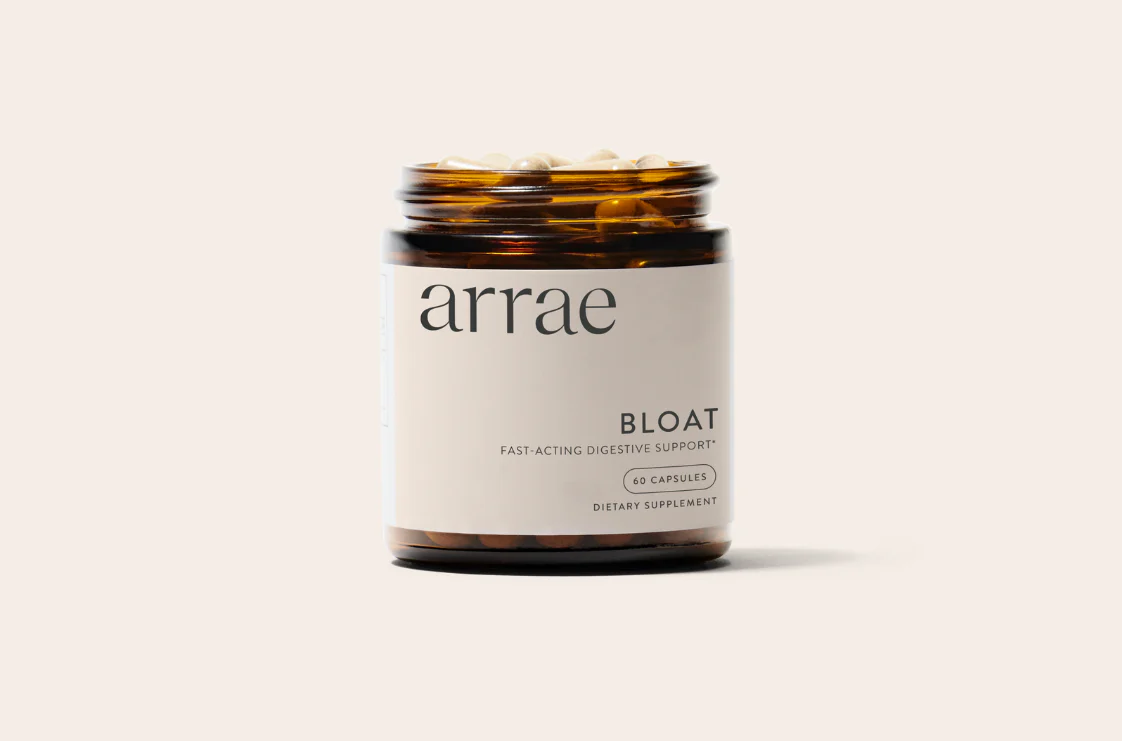
Arrae Bloat is a six-ingredient digestive capsule in the gut healthcategory, targeting post-meal bloating, gas, and general gut discomfort. It launched in March 2020 as Arrae's first product and remains their flagship. The brand was founded by Siff Haider and Nish Samantray — a husband-and-wife team who built it to nine figures in revenue over five years, largely through social media and influencer reach.
The formula contains ginger root extract, dandelion root, lemon balm, peppermint leaf, bromelain (from pineapple), and slippery elm inner bark — all organic. Total active content per 2-capsule serving: 1,300mg. The capsule itself is hypromellose (vegan). Nothing else.
It is positioned as a premium, aesthetically-forward supplement — glass jar, clean design, meant to sit on a counter rather than be hidden in a cabinet. The pricing ($22 for 30 caps) reflects that positioning. It is sold at GNC, Vitamin Shoppe, Ulta, Amazon, and Walmart.
Score Breakdown
FSP composite (4.85) is weighted: Formula 35% · Transparency 25% · Verification 20% · Value 12% · Practical 8%. Red flag deductions applied. Editorial score reflects holistic assessment.
Red & Green Flags
Supplement Facts
| Ingredient | Amount / Serving | Clinical Range |
|---|---|---|
| Organic Ginger Root Extract | 220mg | 1,000–2,000mg |
| Organic Proprietary Blend (5 actives) | 1,080mg | — |
| ↳ Organic Dandelion Root Extract | Undisclosed | — |
| ↳ Organic Lemon Balm Herb Top | Undisclosed | — |
| ↳ Organic Peppermint Leaf Extract | Undisclosed | 200–400mg |
| ↳ Organic Bromelain | Undisclosed | — |
| ↳ Organic Slippery Elm Bark | Undisclosed | — |
| Total Active Per 2-Cap Serving | 1,300mg | — |
Other Ingredients: Hypromellose (Capsule) only · Serving Size: 2 capsules · Servings Per Container: 15
The formula has two disclosed numbers and a significant problem: only ginger (220mg) and the total proprietary blend (1,080mg) are on the label. You get a 1,300mg supplement with one known dose and five unknown ones. The ginger dose is roughly 10–20% of what the evidence supports for meaningful GI effect — clinical IBS and bloating trials use 1,000–2,000mg daily.
Ingredient Breakdown
Ginger (Zingiber officinale) — 220mg →
Ginger accelerates gastric emptying, reduces nausea, and has anti-inflammatory gingerol compounds. Multiple RCTs support gut motility benefit. The effective dose in trials: 1,000–2,000mg daily. At 220mg per serving, Arrae delivers a fraction of that. Whether this sub-clinical dose does anything meaningful is genuinely unclear.
Bromelain (pineapple enzyme) — dose undisclosed
Bromelain is a cysteine protease that breaks down proteins in the gut. It is absorbed orally and biologically active. There is mechanistic rationale for post-meal protein digestion support. However, independent human RCTs specifically for bloating are lacking. Without knowing how much is in the blend, it is impossible to assess dosing adequacy.
Peppermint Leaf Extract — dose undisclosed
The strongest IBS evidence is for enteric-coated peppermint oil capsules (0.2–0.4mL, three times daily) — not peppermint leaf extract. Peppermint leaf extract contains menthol, but the dose needed for smooth-muscle relaxation and its bioavailability in leaf form is not well established. Reasonable inclusion; oil form has stronger evidence.
Dandelion Root Extract — dose undisclosed
Dandelion root has diuretic and mild prebiotic properties. Small studies show it increases urine output. Arrae claims it 'improves liver health' and 'removes excess water.' The diuretic effect is mechanistically plausible but evidence at supplement doses is thin. Its inclusion for bloating related to water retention is reasonable.
Lemon Balm (Melissa officinalis) — dose undisclosed
Lemon balm has anxiolytic and gut-relaxant effects via GABA-A receptor activity. Cases et al. (2011, Mediterranean Journal of Nutrition) showed lemon balm reduced GI symptoms in functional dyspepsia. No independent human trials exist specifically for lemon balm and bloating. Mechanism is plausible given the gut-brain connection in IBS.
Slippery Elm Inner Bark — dose undisclosed
Slippery elm forms a mucilage coating in the GI tract, traditionally used for irritation and inflammation. A 2002 Altern Ther Health Med study found a formula including slippery elm improved IBS-constipation symptoms. Isolated slippery elm human RCT data is essentially absent. Its inclusion is traditional rather than strongly evidence-based.
Testing & Verification
Confirmed
cGMP Certified Facility
Self-reported
FTIR Identity Testing
Self-reported
Heavy Metal Testing
Self-reported
Microbiological Analysis
Not certified
NSF / USP Certified
Not certified
Informed Sport / BSCG
Arrae reports FTIR identity testing, heavy metal analysis, and microbiological testing per batch — but these are brand self-reports. No independent certifying body (NSF, USP, BSCG) publishes or verifies these results. NSF certification specifically verifies that what is on the label is present at the stated dose. Batch COA testing confirms absence of contamination and basic identity — not label accuracy. If you need certified label accuracy, look elsewhere.
Claim Audit
How to Take It
Arrae's recommendation
2–3 caps after meals
Timing
Post-meal or before if prone
Daily use
Safe for daily use
Capsule size
Large — some users struggle with 3
Can open capsules?
Yes — mix in warm water
Storage
Cool, dry place. No refrigeration
One practical note from user reviews: the capsules are on the larger side — some people find swallowing three at once uncomfortable. Arrae confirms the capsule contents can be opened and dissolved in warm water without losing efficacy. The powder has a mild ginger taste.
vs. Competitors
| Product | Price/serve | Enzymes | Herbs | 3rd-party cert | Our take |
|---|---|---|---|---|---|
| Arrae Bloat | $1.47 | 1 (bromelain) | 5 organic | None | Clean label, underdosed ginger, pricey |
| NOW Super Enzymes | $0.19 | 4 (broad spec) | None | NPA A-rated GMP | Best value, no herb support |
| Physician's Choice (16 enzymes) | $0.43 | 16 + probiotics | Ginger, peppermint | None | Broader spectrum, similar price point |
| Enzymedica Digest Gold | $0.89 | 10+ Thera-blend | None | None | Highest enzyme potency, no herbs |
| Perelel Digestive Enzyme | $1.00 | Multi-enzyme | Ginger, licorice, fennel, lemon balm | 3rd-party tested | Closest competitor — similar concept, tested |
Arrae Bloat's closest competitor on concept is Perelel — similar organic herbs, similar target (post-meal comfort), similar price, but with third-party testing. On enzymes alone, NOW Super Enzymes delivers broader coverage at 10× lower cost. Prices verified May 2026.
Products at a Glance
Arrae Bloat reviewed here. If you want a broader-spectrum enzyme option, Physician's Choice is the best direct trade-off on cost and coverage.
Pros & Cons
Strengths
- Completely filler-free — only hypromellose capsule as inactive ingredient
- All six actives are certified organic
- Clean, readable label — no 30-ingredient prop blends or mysterious powders
- Vegan, gluten-free, kosher, non-GMO
- cGMP-certified USA manufacturing
- Widely available — GNC, Vitamin Shoppe, Ulta, Amazon, Walmart
- Capsules can be opened and dissolved in water without losing efficacy
Limitations
- Ginger at 220mg is 10–20% of the dose used in clinical IBS trials (1,000–2,000mg)
- Five of six ingredient doses are hidden in a proprietary blend
- No NSF, USP, Informed Sport, or BSCG certification
- At $1.47/serving, significantly more expensive than broader-spectrum alternatives
- Headline '86% reduction' comes from an industry-sponsored, no-control-group study
- That study also combined Bloat + Calm — not Bloat alone
- Large capsule size — some users struggle swallowing three at once
Safety & Side Effects
At the doses in Arrae Bloat, all six ingredients have generally favourable safety profiles. No serious adverse event reports are on file with the FDA as of May 2026. Some users report mild nausea or stomach discomfort on first use — particularly at 3 capsules with a heavy meal.
Who should be cautious
- People on blood thinners (warfarin) — ginger and bromelain both have mild antiplatelet activity at higher doses
- People with GERD or acid reflux — peppermint can relax the lower esophageal sphincter, potentially worsening reflux
- Kidney disease — dandelion root is a diuretic; discuss with a physician
- Pregnancy — ginger at supplement doses has not been established as safe in pregnancy; consult your doctor
Generally safe for
- Healthy adults with post-meal bloating or IBS-type symptoms
- Daily or as-needed use — no known tolerance or dependency risk
- People with nut, gluten, or dairy restrictions — this product is free of all three
Price & Value
30 caps (one-time)
$22.00
$1.47 at 2 caps
60 caps Amazon
~$36
$1.20 at 2 caps
Subscription (25% off)
~$16.50
$1.10 at 2 caps
GNC retail
$22
Same as direct
Where to Buy
To verify authenticity, buy only from authorised retailers above. Counterfeit listings have appeared on third-party Amazon sellers — check that the sold-by is a verified Arrae seller or Amazon itself. Prices verified May 2026.
FAQ
Final Verdict
FSP · 7/10 · Arrae Bloat
Arrae Bloat is exactly what it says it is: a short, clean-label capsule with six organic herbs and enzymes. The filler-free formula, organic certifications, and readable ingredient list are genuine positives in a category full of over-stuffed proprietary blends.
But the marketing outpaces the evidence. Ginger — the most studied and most important ingredient — is dosed at 220mg when trials use 1,000–2,000mg. Five of six ingredient amounts are invisible. The study Arrae calls proof was 35 people with no control group, funded by a company whose business is running product trials for brands. And the headline percentage wasn't even for Bloat alone.
If you want a clean, short-ingredient digestive supplement and price is not the deciding factor, Arrae Bloat is a defensible choice. If you want maximum transparency, independent certification, or value-for-money on enzymes specifically — look at Perelel (tested, similar concept), Physician's Choice (broader enzymes, fraction of the price), or NOW Super Enzymes ($0.19/serving).
Research References
- Nikkhah Bodagh M et al. (2019). Ginger in gastrointestinal disorders: A systematic review of clinical trials. Food Science & Nutrition. 7(1):96–108. doi →
- ScienceDirect (2024). Preventive and therapeutic effects of ginger on bowel disease: A review of clinical trials. Current Research in Food Science. 8:100099. doi →
- Lohsiriwat S et al. (2010). Effect of ginger on lower esophageal sphincter pressure. Journal of the Medical Association of Thailand. 93(3):366–372. doi →
- Cappello G et al. (2007). Peppermint oil in the treatment of irritable bowel syndrome: a prospective double blind placebo-controlled randomized trial. Digestive and Liver Disease. 39(6):530–536. doi →
- Cases J et al. (2011). Pilot trial of Melissa officinalis L. leaf extract in the treatment of volunteers suffering from mild-to-moderate anxiety disorders and sleep disturbances. Mediterranean Journal of Nutrition and Metabolism. 4(3):211–218. doi →
- Braun JM et al. (2002). Use of herbal medicines by patients with irritable bowel syndrome. Alimentary Pharmacology & Therapeutics. 16(7):1445–1452. doi →
- Citrus Labs (2022). Study to Evaluate the Efficacy of Arrae's Bloat & Calm Alchemy Capsules. ClinicalTrials.gov Identifier: NCT05197413. doi →
- KGK Science (registered 2025). Clinical Trial to Investigate the Safety and Efficacy of Bloat on Gas and Bloating in Healthy Women. ClinicalTrials.gov Identifier: NCT07370740. doi →
- Holtmann G et al. (2003). Efficacy of artichoke leaf extract in the treatment of patients with functional dyspepsia: a six-week placebo-controlled, double-blind, multicentre trial. Alimentary Pharmacology & Therapeutics. 18(11-12):1099–1105. doi →
- Shekelle PG et al. (2003). Efficacy and safety of ephedra and ephedrine for weight loss and athletic performance: a meta-analysis. JAMA. 289(12):1537–1545. doi →