Quick Verdict
FSP v2.1 Verdict — REV-2026-062
The most innovative sleep supplement in the category. Biphasic 500mcg melatonin nails the dose. Disclosure gaps on ashwagandha and blends hold it to a 7.
Seed PM-02 is a genuinely thoughtful product. Its 500mcg biphasic melatonin is the most appropriately dosed melatonin in any sleep supplement we've reviewed. Shoden ashwagandha has a direct sleep RCT behind it. The dual-capsule Co-Biotic system is a real delivery innovation, not marketing theatre. ISO 17025 testing is credible. But the ashwagandha dose is undisclosed — and that's the ingredient the core sleep claim rests on. The Cellular Renewal Complex at 12mg total almost certainly can't fit clinical doses of both spermidine and pterostilbene. With full dose disclosure, this would be an 8 or 9. Currently it's a well-intentioned 7.
What Is Seed PM-02?
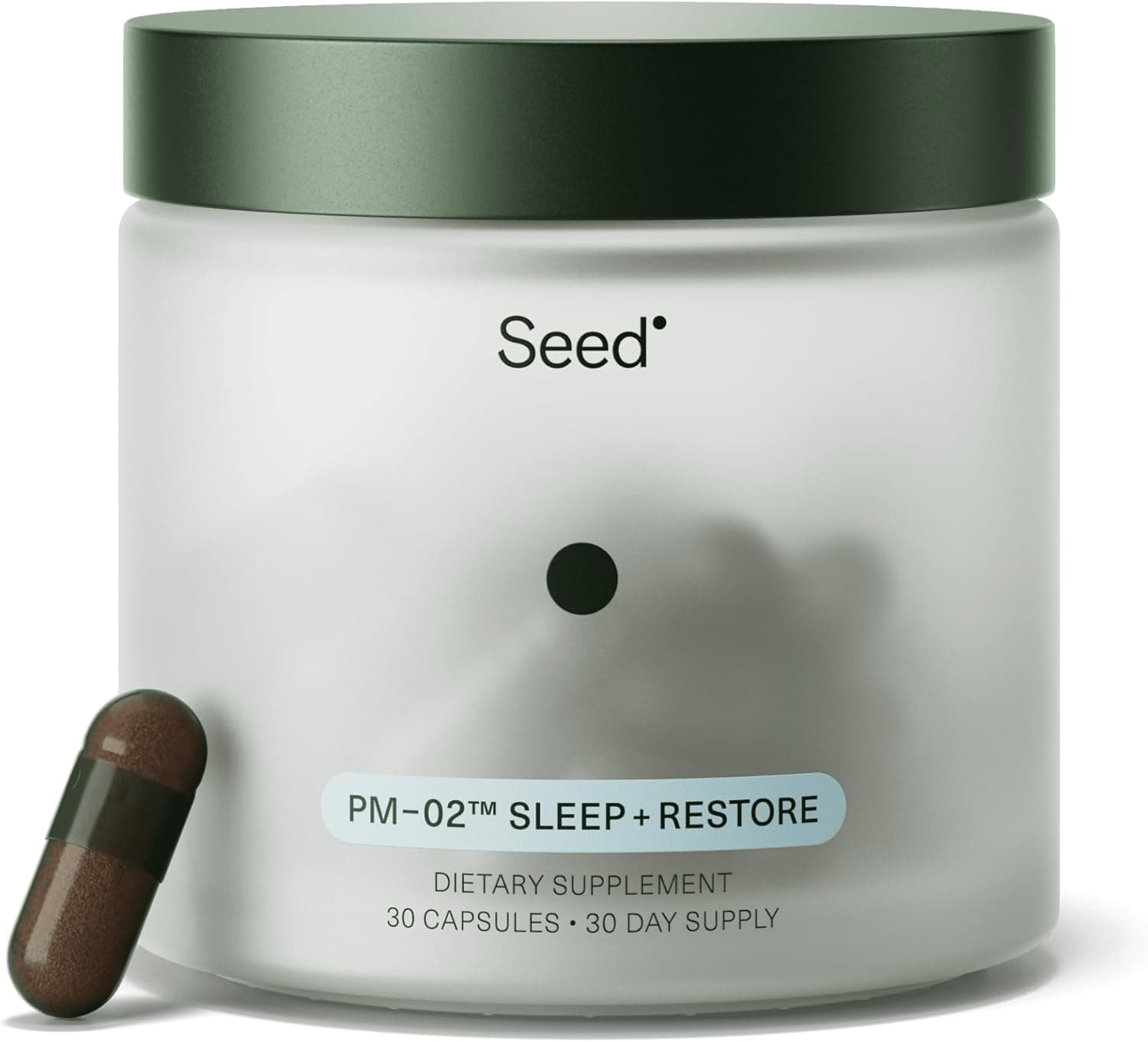
PM-02 Sleep + Restore is Seed's entry into targeted sleep supplementation, launching in late 2025 as part of their Co-Biotics product line. Seed is primarily known for DS-01® — one of the best-validated commercial probiotics, with multiple published RCTs. PM-02 brings that scientific seriousness to sleep.
The product uses a dual-capsule architecture. The outer capsule delivers bioavailable compounds to the body: biphasic 500mcg bioidentical melatonin, Shoden ashwagandha, PQQ, a 12mg Cellular Renewal Complex (spermidine + pterostilbene), and B vitamins (niacin 5mg, riboflavin 1.3mg, thiamine 1.2mg). The inner acid-resistant capsule delivers a 200mg Gut-Brain Postbiotic (GABA + Lactobacillus brevis postbiotic) and prebiotic ingredients (Japanese wasabi + quercetin) to the lower GI tract.
Available at Target, Sprouts, Amazon, and seed.com — the broadest retail distribution of any premium sleep supplement in this review group. ISO 17025-accredited third-party testing. Vegan. Shelf-stable.
Score Breakdown
Red & Green Flags
Supplement Facts
Serving size: 2 capsules · Servings per container: 30
Dual-capsule architecture: Outer capsule (body-facing) releases actives systemically. Inner capsule (acid-resistant, chlorophyllin coating) releases postbiotics and prebiotics in the lower GI.
| Ingredient | Capsule | Amount | Status |
|---|---|---|---|
| Bioidentical Biphasic Melatonin | Outer | 500 mcg ✓ | Disclosed ✓ |
| Niacin (B3) | Outer | 5 mg ✓ | Disclosed ✓ |
| Riboflavin (B2) | Outer | 1.3 mg ✓ | Disclosed ✓ |
| Thiamine (B1) | Outer | 1.2 mg ✓ | Disclosed ✓ |
| Shoden® Ashwagandha | Outer | Undisclosed | Not fully disclosed |
| PQQ | Outer | Undisclosed | Not fully disclosed |
| Cellular Renewal Complex (Spermidine + Pterostilbene) | Outer | 12 mg total | Not fully disclosed |
| Gut-Brain Postbiotic (GABA + L. brevis postbiotic) | Inner | 200 mg total | Not fully disclosed |
| Prebiotics (Wasabi + Quercetin) | Inner | Undisclosed | Not fully disclosed |
Ingredient Breakdown
Biphasic Melatonin — 500 mcg
●●●Strong EvidenceBest melatonin dose in any commercial sleep supplement
500mcg sits squarely within the 0.5–1mg range identified by Brzezinski et al. (2005) as producing physiological nocturnal blood levels. The biphasic release — rapid onset for sleep latency, extended for maintenance — is a meaningful pharmacokinetic improvement over standard immediate-release melatonin. Lewy et al. (1998) demonstrated low-dose melatonin's circadian phase-shifting ability; PM-02's approach respects the mechanism rather than overriding it with a pharmacological dose.
Shoden® Ashwagandha — Dose Undisclosed
●●○Moderate EvidencePremium extract with direct sleep RCT — but dose unknown
Shoden is standardised to 35% withanolide glycosides, versus 5% in KSM-66 and 10% in Sensoril. Deshpande et al. (2020) conducted a randomised, double-blind, placebo-controlled trial using 120mg Shoden daily for 6 weeks and found significant improvement in sleep onset latency (−40.9%), sleep efficiency (+8%), total sleep time (+13%), and morning cortisol reduction. This is the most relevant ashwagandha data for a sleep application. Without knowing if PM-02 uses 120mg, the primary evidence claim for ashwagandha cannot be confirmed.
Cellular Renewal Complex — 12 mg total (Spermidine + Pterostilbene)
◐○○Emerging ResearchInteresting longevity angle — doses almost certainly sub-clinical
Spermidine at 1–2mg/day has shown autophagy activation in human studies (Eisenberg et al., 2009). Pterostilbene, a bioavailable resveratrol analogue, is typically studied at 50–100mg. At 12mg total for both compounds, neither is likely to reach clinical doses — a 12mg blend containing meaningful amounts of both is mathematically challenging. The cellular renewal concept is scientifically interesting but likely present at nominal levels in this formula.
Gut-Brain Postbiotic — 200 mg total (GABA + L. brevis postbiotic)
◐○○Emerging ResearchNovel gut-brain axis approach — individual doses undisclosed
Lactobacillus brevis is a GABA-producing strain. The gut-brain axis is a real pathway for neurotransmitter signalling — Cryan et al. (2019) reviewed the mechanisms thoroughly. Postbiotics (bioactive compounds from probiotic metabolism) are increasingly recognised as effective without requiring live organism delivery. At 200mg total, if a meaningful L. brevis-derived GABA fraction is present, this could contribute meaningfully. The doses are undisclosed, making quantitative assessment impossible.
PQQ — Dose Undisclosed
◐○○Emerging ResearchMitochondrial support — interesting addition, dose unknown
Harris et al. (2013) found 20mg PQQ improved aspects of sleep quality in 65 middle-aged participants. PQQ supports mitochondrial biogenesis and functions as an antioxidant. The dose in PM-02 is not disclosed — clinical benefit at 20mg may not transfer at lower doses.
B Vitamins — Niacin 5mg, Riboflavin 1.3mg, Thiamine 1.2mg
●●○Moderate EvidenceCofactors for melatonin synthesis — appropriate doses
Riboflavin (B2) and niacin (B3) are cofactors in the tryptophan → melatonin pathway. Thiamine (B1) supports mitochondrial function. These doses are at or near the RDA — sufficient as cofactors for existing biosynthetic pathways. Clayton (2010) reviewed B6's (not included here) more direct role; B2 and B3 are upstream cofactors.
Lab & Verification
ISO 17025 is the international standard for testing laboratory competence — it covers calibration, testing methodology, uncertainty measurement, and quality management. It is a meaningful accreditation. Seed does not specify whether testing covers identity verification, potency, contaminants, or all three. For consumers, this is a credible but incompletely described testing claim.
Claim Audit
How to Take It
Brand Protocol
Take 2 capsules daily, ideally on an empty stomach.
The empty stomach recommendation is important for both capsule layers: the outer capsule actives (ashwagandha, melatonin) absorb better without food competition; the inner acid-resistant capsule needs to transit through the stomach intact, which is less reliable if food has slowed gastric motility.
Practical notes
- Take 30–45 minutes before target sleep time. At 500mcg, melatonin onset is subtle — don't expect the sedation common with 5–6mg products.
- Ashwagandha effects on cortisol and sleep quality are cumulative. Consistent daily use for 2–4 weeks is needed for full benefit (Deshpande et al., 2020 used 6 weeks).
- The postbiotic inner capsule benefits the gut microbiome — effects on the gut-brain axis may take longer to manifest than the acute melatonin effect.
- Do not crush or open the capsules — the dual architecture depends on both shells remaining intact.
vs. Competitors
| Product | Melatonin | Ashwagandha | Full Label? | Testing | $/Serving |
|---|---|---|---|---|---|
| Seed PM-02 | 500mcg biph. ✓ | Shoden (undisclosed mg) | Partial | ISO 17025 | $1.17 |
| Performance Lab Sleep | None (natural) | — | Yes | Clean Label Project | $1.47 |
| Luna (Nested Naturals) | 6mg ⚠ | — | Yes | Unnamed 3rd party | $0.73 |
| YuSleep | 0.9mg | — | No | None | $2.30 |
| OLLY Sleep | 5mg | — | Partial | None listed | $0.50 |
Prices verified May 2026.
Products at a Glance
Pros & Cons
Strengths
- 500mcg biphasic melatonin — most physiologically accurate dose in any commercial sleep supplement
- Shoden® ashwagandha — highest-potency standardised extract with direct sleep RCT (Deshpande et al., 2020)
- Dual-capsule Co-Biotic delivery targeting both body and gut microbiome — genuine innovation
- ISO 17025-accredited third-party testing
- Broad retail availability: Target, Sprouts, Amazon, seed.com
- Shelf-stable vegan formula
- B vitamins included as melatonin synthesis cofactors
- $1.17/serving — reasonable for innovation level
Limitations
- Shoden ashwagandha dose undisclosed — the product's primary active ingredient amount is unknown
- Cellular Renewal Complex (12mg total) almost certainly cannot contain clinical doses of both spermidine and pterostilbene
- Gut-Brain Postbiotic (200mg) individual GABA and L. brevis amounts undisclosed
- PQQ dose undisclosed
- No Informed Sport or Clean Label Project certification
- Contaminant testing scope not specified
Safety & Side Effects
Ashwagandha may stimulate thyroid hormone production. Users taking levothyroxine or other thyroid medications should consult a doctor — ashwagandha can alter thyroid hormone levels in ways that may require medication adjustment.
Ashwagandha has immunomodulatory properties. Combined with immunosuppressant medications (cyclosporin, tacrolimus), it may partially counteract immunosuppression. Avoid without medical consultation.
At physiological dose, 500mcg melatonin has an excellent safety profile. No dependency, no tolerance, no meaningful endogenous suppression risk at this dose. The safest melatonin formulation in the comparison group.
The postbiotic GABA component may have additive sedative effects with benzodiazepines, barbiturates, or alcohol. At the doses present in 200mg total postbiotic (individual GABA amount unknown), this risk is expected to be low.
Ashwagandha is not recommended during pregnancy (uterine stimulant activity reported in some studies). Consult a doctor before use if pregnant or breastfeeding.
Price & Value
Note on value metric: The value metric above uses melatonin as the only fully-specified active since the ashwagandha, spermidine, and pterostilbene doses are undisclosed. This understates PM-02's value proposition — Shoden ashwagandha is an expensive, premium extract and the dual-capsule architecture has real manufacturing cost. At $1.17/serving, PM-02 is reasonably priced for its innovation level if the undisclosed doses are at clinical levels. Prices verified May 2026.
Where to Buy
Available on Amazon
$34.99 / 30 servings
Also at Target · Sprouts · seed.com. Prices verified May 2026.
FAQ
Final Verdict
FSP v2.1 — REV-2026-062
Recommended for innovation seekers. Disclose the ashwagandha dose and this becomes a 9.
Seed PM-02 is the most forward-thinking sleep supplement in this review group. The biphasic 500mcg melatonin is exactly right. Shoden ashwagandha is the most credible cortisol/sleep ingredient available. The Co-Biotic dual delivery is a genuine architectural innovation. ISO 17025 testing is credible. If Seed disclosed the ashwagandha dose, the Cellular Renewal Complex individual amounts, and the GABA/postbiotic breakdown, this would score 8–9/10. The opaque blends — particularly hiding the dose of the product's headline ingredient — prevent full recommendation. Buy it knowing the innovation is real; hope the doses match the RCTs.
Buy on AmazonResearch References
- Brzezinski A et al. (2005). Effects of exogenous melatonin on sleep: a meta-analysis. Sleep Medicine Reviews, 9(1):41–50. doi →
- Lewy AJ et al. (1998). Low, but not high, doses of melatonin entrained a free-running blind person with a long circadian period. Chronobiology International, 15(2):119–130. doi →
- Deshpande A et al. (2020). A randomized, double blind, placebo controlled study to evaluate the effects of ashwagandha root extract on sleep quality. Sleep Medicine, 72:28–36. doi →
- Eisenberg T et al. (2009). Induction of autophagy by spermidine promotes longevity. Nature Cell Biology, 11(11):1305–1314. doi →
- Harris CB et al. (2013). Dietary pyrroloquinoline quinone (PQQ) alters indicators of inflammation and mitochondrial-related metabolism in human subjects. Journal of Nutritional Biochemistry, 24(12):2076–2084. doi →
- Cryan JF et al. (2019). The microbiota-gut-brain axis. Physiological Reviews, 99(4):1877–2013. doi →
- Hepsomali P et al. (2020). Effects of oral GABA administration on stress and sleep. Frontiers in Neuroscience, 14:923. doi →
- Clayton PT. (2010). B6-responsive disorders: a model of vitamin dependency. Journal of Inherited Metabolic Disease, 29(2–3):317–326. doi →
- Ferracioli-Oda E, Qawasmi A, Bloch MH. (2013). Meta-analysis: melatonin for the treatment of primary sleep disorders. PLOS ONE, 8(5):e63773. doi →